
All the downloads for VASM seem to 404, only host old versions, or give security errors.
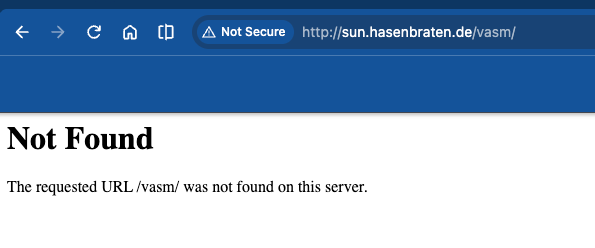
Until the official website is updated, Archive.org looks like the best option for downloading as I type this:
https://web.archive.org/web/20260903181534/http://sun.hasenbraten.de/vasm
The newest version on that archived page is vasm 2.0f, dated 10 July 2026. The one before it, 2.0e, came out on 24 February 2026.
The page itself is the index. The source it links to was saved on 3 September 2026, and this link downloads that original file: vasm.tar.gz (vasm 2.0f, archive.org)
It is 605,655 bytes. Checksums so you can check yours matches the one I used:
SHA-256: c84b2de1cbb87831795fe64a85c5d9a7002a766e3a7c30b0a2d7d5e99d878f49
SHA-1:   b1749c849dacea3de04e1d08e8c9b715af13282a
The SHA-1 matches the one the Wayback Machine recorded when it saved the file, so it is what came off the author’s server.

Building vasm 2.0f
It is source only. You build one assembler per CPU and syntax pair, and all you need is a C compiler and make (Mac or Linux):
tar xzf vasm.tar.gz
cd vasm
make CPU=z80 SYNTAX=oldstyle     # vasmz80_oldstyle
make CPU=6502 SYNTAX=oldstyle    # vasm6502_oldstyle
make CPU=6809 SYNTAX=oldstyle    # vasm6809_oldstyle
make CPU=m68k SYNTAX=mot         # vasmm68k_mot
Each binary is named after its pair. Delete obj/*.o between builds if make complains.
Watch out for old copies
www.ibaug.de/vasm/vasm.tar.gz, which the author’s compilers.de page links to, is vasm 1.8i from 2020. The ibaug.de home page itself is a parked domain, which does not inspire confidence.
The ChibiAkumas DevTools 2026 bundles include vasm 1.8c from 2018, as Windows builds only.
I found this out because crustyBASIC’s Z80 output needs vasm 2.x. The 1.8i Z80 module reads org $8000 as org $ (the current address) followed by junk, gives warning 1007 “garbage at end of line”, and assembles everything at address 0. The Spectrum just crashed.
What is VASM?
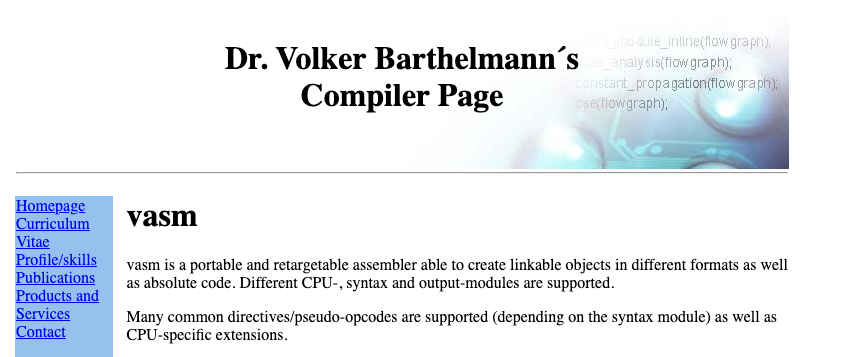
vasm is a portable and retargetable assembler able to create linkable objects in different formats as well as absolute code. Different CPU-, syntax and output-modules are supported.
Many common directives/pseudo-opcodes are supported (depending on the syntax module) as well as CPU-specific extensions.
The assembler supports optimizations and relaxations (e.g. choosing the shortest possible branch instruction or addressing mode as well as converting a branch to an absolute jump if necessary).The following architectures are currently supported by vasm:
- M680x0 family (including M6888x, M68851 and CPU32)
- ColdFire family (all models of V2, V3, V4, V4e)
- PowerPC family (POWER, 40x, 440, 460, 6xx, 7xx, 7xxx, 860, Book-E, e300 and e500)
- Z80 family (Z80, 8080, GBZ80, 64180, RCM2/3/4k)
- 6502 family
- Jaguar RISC (GPU and DSP instruction sets)
- ARM (architecture ARMv1 to ARMv4, including THUMB mode)
- 80×86 family (IA32 8/16/32 bit, using MIT-syntax)
- C16x/ST10
- 6800 family (6800, 6801, 6803, 68HC11)
- QNICE (elegant 16-bit FPGA CPU)
- TR3200 (virtual CPU from 0x10c)
- Raspberry-Pi VideoCore IV
That list is from the compilers.de page, which describes an older vasm. The 2.0f source also has CPU modules for the 6809 (plus 6309 and 68HC12), PDP-11, Sony SPC700, Wozniak’s Sweet16, unSP and Hans, and its 6502 module covers the 65C02 and 65816. QNICE, in the list above, is not in the 2.0f source.
Supported linkable object formats include:
- ELF (M68k, PowerPC, i386, ARM and JRISC)
- a.out (M68k, i386 and JRISC)
- Amiga hunk format (M68k)
- Atari TOS executable format (M68k)
- Sharp X68000 Xfile format (M68k)
- EHF extended hunk format (PowerPC)
- Raw, binary output (all)
- Motorola Srecord format (all)
- VOBJ proprietary versatile object format (all)
- Test, debugging output (all, default)
2.0f’s output modules also include Intel hex, o65, COFF, Acorn AOF, GST, WOZ, PAP and C defines (cdef).
 C64 BASIC Dungeon Crawler: More BASIC Optimisations (Part 14)